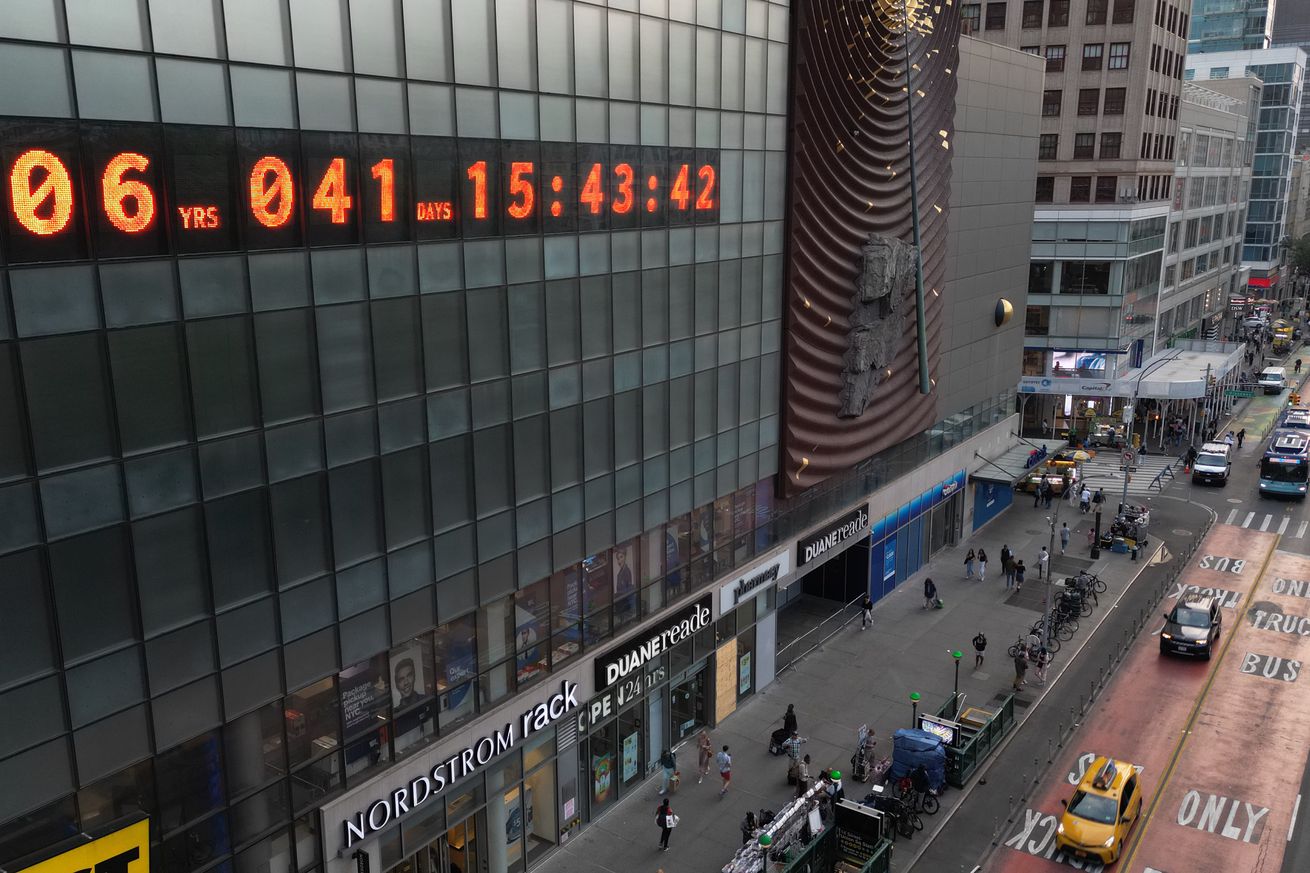
Time is running out on the Climate Clock

A digital clock displayed on a building facade reads: 06 years and 041 days.
The Climate Clock in New York City’s Union Square in early July 2023. | Image: Climate Clock

An ominous, 62-foot-long clock looms over New York City’s iconic Union Square, and it’s about to tick past a worrying milestone. It’s called the Climate Clock, and it counts down how much time the world has left to stop climate change from becoming exponentially worse.

As anyone who’s experienced the weather lately knows, the situation is already bad. The world had its hottest week on record at the start of the month, according to preliminary data, with heatwaves still smashing local records across the Northern Hemisphere. And that’s just one way climate change is bringing on dangerous new extremes.

Today, the planet is about 1.1 degrees Celsius hotter than it was before the Industrial Revolution, thanks to carbon dioxide emissions from...

Continue reading…


from The Verge - All Posts https://ift.tt/dkV1CXn

Comments

Popular posts from this blog

Pandora Stories lets artists add commentary to their own playlists

Pandora launched Stories today, a tool that lets artists and creators add voice commentary to their own playlists. The Stories feature merges podcasts with music playlists, and is meant for artists to add context to an album, or for podcasters to experiment with new storytelling formats. The feature is part of Pandora AMP, the streaming service’s free Artist Marketing Platform that helps creators promote their work. To kick off the launch, Pandora’s prepared some Stories by artists like John Legend and Daddy Yankee, who tell listeners their personal stories interspersed between their own songs. There’s also a Stories playlist called Love Songs That Aren’t Really Love Songs , which includes commentary on individual songs like a podcast... Continue reading… from The Verge - All Posts https://ift.tt/2Xz1oNc

Instagram’s updated algorithm prioritizes original content instead of rip-offs

Image: Kristen Radtke / The Verge Instagram is making significant changes to how its system recommends content, with a focus on original content and increased distribution for smaller accounts. The slew of changes were announced by the company in a blog post today. The biggest change deals with aggregators — accounts that download or screenshot other users’ videos and photos and repost them. Sometimes aggregators will credit the original poster by tagging them in the post or caption, but often, content is wholesale ripped off with no acknowledgment, and engagement is siphoned off from the person who created the content in the first place. Instagram clearly has a problem with this and will begin removing reposted content from recommendations across the platform. The... Continue reading… from The Verge - All Posts https://ift.tt/ECgcPAU

We asked camera companies why their RAW formats are all different and confusing

When you set up a new camera, or even go to take a picture on some smartphones, you’re presented with a key choice: JPG or RAW? JPGs are ready to post just about anywhere, while RAWs yield an unfinished file filled with extra data that allows for much richer post-processing. That option for a RAW file (and even the generic name, RAW) has been standardized across the camera industry — but despite that, the camera world has never actually settled on one standardized RAW format. Most cameras capture RAW files in proprietary formats, like Canon’s CR3, Nikon’s NEF, and Sony’s ARW. The result is a world of compatibility issues. Photo editing software needs to specifically support not just each manufacturer’s file type but also make changes for each new camera that shoots it. That creates pain for app developers and early camera adopters who want to know that their preferred software will just work. Adobe tried to solve this problem years ago with a universal RAW form...